

Author: aluna Analytics | Date: 29 April 2026 | Category: Market Intelligence
PT Chandra Daya Investasi Tbk ($CDIA), operating as the consolidated infrastructure, logistics, and utility arm of the Chandra Asri Group and Thailand’s EGCO Group, presents a highly complex and ultimately precarious investment narrative. The company has aggressively positioned itself as an integrated infrastructure growth partner for Southeast Asia’s industrial sector, specifically aiming to capitalize on the rapid expansion of the Cilegon industrial hub and broader Indonesian manufacturing mandates. Since its highly successful initial public offering in July 2025, the underlying corporate narrative promoted by management has heavily emphasized recurring revenues, structurally secured demand, and robust adjusted EBITDA growth.
However, a forensic examination of the unaudited interim consolidated financial statements for the first quarter ending March 31, 2026, reveals a starkly different economic reality. Behind the veneer of a 19.0% year-over-year revenue expansion and a heavily touted 125.4% surge in adjusted EBITDA, the fundamental economics of the core operations are deteriorating rapidly. The company reported a net profit of US$ 9.47 million for the first quarter of 2026, representing a precipitous 68.6% collapse from the US$ 30.23 million recorded during the same period in the previous year. More alarmingly, these reported accounting earnings are entirely unsupported by actual cash generation; the company recorded negative operating cash flows of US$ 856,437 during the quarter.
The expansion of the balance sheet introduces severe structural vulnerabilities. While the company boasts a massive liquidity pool of US$ 703.36 million, it has simultaneously accumulated US$ 707.62 million in long-term bank debt subject to floating interest rates, which has driven finance costs up by 64.1% year-over-year. Crucially, over US$ 441 million of the company’s capital is deployed not into productive, cash-generating infrastructure, but into “Equity Linked Bonds” and debt instruments issued by its parent company or affiliates. This internal capital allocation transforms CDIA from a pure-play infrastructure compounder into an internal financing vehicle for the broader Chandra Asri ecosystem, exposing minority public shareholders to severe corporate governance risks and value tunneling.
Trading at an implied price-to-earnings multiple exceeding 54x following massive stock price appreciation since its initial public offering, the public market is currently pricing CDIA for flawless, exponential growth. Given the acute compression in gross margins, the reliance on non-cash paper gains to report profitability, the extreme vulnerability to floating interest rates, and the structural cash consumption of its core operations, this valuation is fundamentally detached from intrinsic value. The investment perspective on CDIA is one of high conviction to avoid. The business exhibits the characteristics of a structurally challenged operator masked by complex financial engineering and aggressive accounting classifications, rendering the equity highly vulnerable to a severe market correction once the lack of free cash flow generation becomes apparent to institutional investors.
Business Profile, Corporate Structure, and Asset Quality
To properly evaluate the financial mechanics of PT Chandra Daya Investasi Tbk, it is necessary to deconstruct its complex operational pillars and subsidiary structures. The company operates as a holding entity that acquires, develops, and manages infrastructure assets critical to the downstream chemical, steel, and manufacturing industries in Indonesia. Following the acquisition of a 30% stake by the EGCO Group for US$ 194 million, the company consolidated a variety of regional assets to form four primary business pillars: energy, maritime and land logistics, port and storage, and industrial water treatment.
The energy segment, primarily managed through the 70% owned subsidiary PT Krakatau Chandra Energi (KCE), forms the operational backbone of the company’s utility operations. KCE operates a 120-megawatt Combined Cycle Power Plant (PLTGU) fueled by natural gas, which acts as the primary electricity provider for the Krakatau Industrial Estate in Cilegon. This segment benefits from a captive market, supplying baseload power to heavy industrial users including PT Krakatau Steel (Persero) Tbk and various Chandra Asri chemical facilities. The company also holds a 45% associate stake in PT Krakatau Posco Energy (KPE), which operates a 200-megawatt coal-fired power plant. While the company has initiated investments in renewable energy, notably expanding its solar power capacity to 11 megawatt-peak (MWp) through ground-mounted and rooftop installations managed by KCE, the core energy generation remains overwhelmingly dependent on fossil fuels. This heavy reliance on coal and natural gas provides high utilization rates and highly visible short-term revenues, but it exposes the company to long-term regulatory risks and carbon transition headwinds, especially as global capital increasingly shuns carbon-intensive infrastructure.
The logistics and maritime segment operates through subsidiaries such as PT Chandra Shipping International (CSI) and PT Marina Indah Maritim (MIM), in which CDIA exercises operational control despite holding a 49% equity stake due to board composition and governance agreements. This division manages a growing fleet of 14 gas and chemical tankers, providing specialized sea transportation for petrochemical products. Recent strategic additions to this fleet include the Boreas, a 9,000 deadweight ton (DWT) liquid chemical vessel launched in April 2026, alongside the upcoming Novah vessel slated for operation later in the year. The economics of this segment are currently highly favorable. The global liquid chemical shipping market is experiencing structural capacity constraints due to geopolitical rerouting, an aging global fleet, and surging demand for the transport of biofuels and specialized chemicals. These macroeconomic factors have elevated spot freight rates, allowing CDIA to generate significant top-line growth in this division. However, maritime shipping remains a notoriously cyclical industry; while currently operating at peak profitability, these margins are inherently vulnerable to rapid reversal as global shipping capacities inevitably normalize.
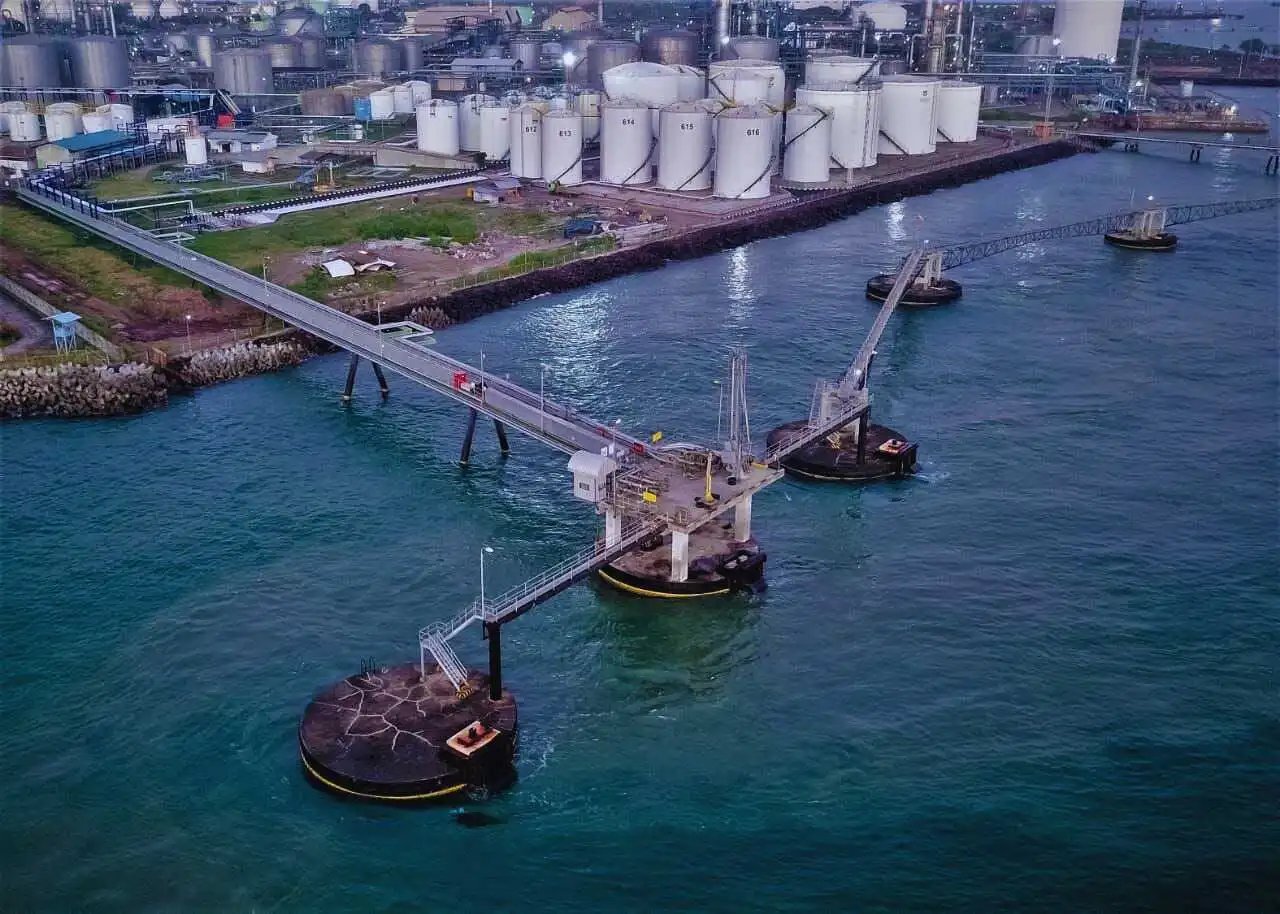
The port and storage segment is anchored by PT Redeco Petrolin Utama (RPU), in which CDIA holds a 50.75% stake. RPU manages strategic jetty facilities and tank terminals in Banten, offering essential liquid bulk storage for chemical and petroleum products. The company is actively expanding this footprint, investing in new ethylene pipelines and bitumen tank facilities to integrate further into the regional supply chain and serve external clients. Because storage and port facilities located within designated industrial zones benefit from exceptionally high barriers to entry and regulatory monopolies, this segment represents the highest quality, most durable economic moat within the portfolio.
Finally, the water treatment segment operates through a 49% associate stake in PT Krakatau Tirta Industri (KTI), which manages the abstraction, purification, and distribution of raw and clean water from the Cidanau and Cipasauran rivers to the Cilegon industrial cluster. Similar to the port segment, industrial water distribution is a highly scalable, utility-like business characterized by long-term contracts and inelastic demand, providing a reliable stream of associate income to the parent holding company.
Macroeconomic Backdrop and Industry Dynamics
The operational environment presents a complex mixture of structural tailwinds and cyclical vulnerabilities. The Indonesian economy is forecast to grow at a stable rate of 4.9% to 5.0% through 2026, driven by robust domestic consumption and targeted infrastructure spending under the National Medium-Term Development Plan (RPJMN 2025-2029). The government’s strategic focus on reducing national logistics costs—which remain stubbornly high compared to regional peers—provides a highly favorable policy backdrop for ongoing expansion in maritime logistics, land transport, and integrated warehousing.
In the energy sector, industrial electricity demand continues to surge, particularly in heavy manufacturing zones like Cilegon. The ongoing expansion of national steel production capacities, highlighted by the massive joint venture between state-owned Krakatau Steel and China’s Delong Steel Group, guarantees a rising baseload power requirement that directly benefits KCE and KPE. However, this growth is inextricably tethered to legacy fossil-fuel generation. While domestic coal and natural gas currently provide essential grid stability and cost predictability for industrial consumers, the Indonesian regulatory framework is slowly but inevitably pivoting. The national strategy to phase out coal by 2040 and dramatically increase the variable renewable energy mix exposes CDIA’s 320-megawatt fossil fleet to eventual stranded-asset risks. The company’s current foray into renewables—amounting to a meager 11 MWp of solar capacity—is entirely insufficient to offset the long-term carbon liabilities embedded in its core generation assets. The tension between immediate industrial energy needs and long-term decarbonization mandates remains the most significant unresolved strategic risk for the company’s energy pillar.
The maritime logistics segment is currently the primary growth engine for the group, riding a wave of favorable macroeconomic dynamics. The global liquid chemical shipping market is experiencing heightened demand driven by the transport of bio-based chemicals, vegetable oils, and advanced petrochemicals. More critically, global supply chain inefficiencies, fleet aging, and geographic rerouting away from conflict zones have tightened available tonnage, artificially inflating spot freight rates globally. CDIA has aggressively capitalized on this dynamic by expanding its fleet with the Boreas and Novah vessels. However, as the maritime industry has historically proven across multiple cycles, elevated charter rates inevitably trigger over-ordering at shipyards and subsequent capacity gluts. The current outperformance in logistics revenue must be viewed as cyclical rather than structural, and investors should exercise extreme caution before extrapolating the robust Q1 2026 logistics margins into perpetuity.
Initial Public Offering and Capital Allocation Strategy
The capitalization trajectory is defined by its recent transition to public markets and the subsequent, highly aggressive corporate actions taken by management. On July 9, 2025, PT Chandra Daya Investasi Tbk officially listed its shares on the Development Board of the Indonesia Stock Exchange. The company successfully raised IDR 2.37 trillion (approximately US$ 142 million) by issuing 12.48 billion new shares at an offering price of IDR 190 per share, representing 10% of the total enlarged capital. The offering was met with overwhelming market enthusiasm, recording an oversubscription rate of 563.64 times, reflecting deep retail and institutional appetite for infrastructure assets.
The stated intent of the IPO proceeds was the capitalization of the company’s subsidiary network to accelerate infrastructure development. Specifically, the prospectus outlined that the funds would be directed toward PT Chandra Shipping International (CSI) and PT Marina Indah Maritim (MIM) for the acquisition of new chemical tankers, and toward PT Chandra Samudera Port (CSP) for the expansion of port and storage facilities. This narrative of deploying public capital to build tangible, cash-generating assets was the primary catalyst for the stock’s initial surge.
However, the capital allocation strategy rapidly deviated into aggressive financial engineering. By February 2026, a mere seven months after the IPO, the company announced a massive share buyback program with an allocated budget of IDR 1 trillion, scheduled to run from February 6, 2026, to May 5, 2026. The stated rationale for the buyback was to increase shareholder value and maintain stock price stability. Executing a share buyback of this magnitude—representing nearly half of the total funds raised during the IPO—so soon after going public is a highly irregular capital allocation decision for a purportedly high-growth infrastructure developer. It suggests that management prioritizes short-term equity market engineering over long-term capital expenditure, raising serious questions about the actual capital requirements of the underlying infrastructure projects and the true motives behind the public listing.
Line chart of Chandra Daya Investasi Tbk (CDIA) with timeframe 1 Year.
Income Statement Analysis: Growth Drivers and Margin Dynamics
An analytical dissection of the interim consolidated statement of profit or loss for the three months ended March 31, 2026, reveals a significant and troubling divergence between top-line expansion and bottom-line realization, highlighting severe structural pressures on core profitability.
| Income Statement Component | Q1 2026 (US$) | Q1 2025 (US$) | YoY Change (%) |
|---|---|---|---|
| Revenues | 41,240,230 | 34,644,752 | + 19.0% |
| Cost of Revenues | (31,165,921) | (25,438,692) | + 22.5% |
| Gross Profit | 10,074,309 | 9,206,060 | + 9.4% |
| Selling Expenses | (352,937) | (331,009) | + 6.6% |
| General and Administrative | (4,924,802) | (3,581,195) | + 37.5% |
| Finance Costs | (10,188,228) | (6,207,078) | + 64.1% |
| Finance Income | 6,293,452 | 6,142,251 | + 2.4% |
| Income from Financial Assets | 5,548,799 | 5,548,799 | 0.0% |
| Share in Profit of Associates | 4,315,046 | 2,241,607 | + 92.5% |
| Other Gains (Loss) – Net | (360,317) | 14,720,170 | N/A |
| Profit Before Tax | 11,930,909 | 30,250,797 | – 60.5% |
| Net Profit for the Period | 9,479,830 | 30,232,349 | – 68.6% |
Top-line revenue grew by a robust 19.0% to US$ 41.24 million, driven primarily by the expansion of the maritime logistics fleet, elevated spot charter rates, and steady electricity dispatch volumes to the captive industrial client base. However, the cost of revenues significantly outpaced top-line growth, surging by 22.5% to US$ 31.16 million. Consequently, gross margins compressed from 26.5% in Q1 2025 down to 24.4% in Q1 2026. This margin decay clearly indicates that despite favorable pricing power in the logistics market, the company is facing escalating input costs. These are likely tied to global fuel price volatility, inflationary pressures on maintenance, and increased depreciation expenses associated with the newly capitalized vessels and power infrastructure, with depreciation alone accounting for US$ 3.97 million of the cost of revenues.
The narrative of operational leverage breaks down completely when evaluating the core operating profitability. General and administrative expenses ballooned by 37.5% to US$ 4.92 million, indicative of the expanding corporate overhead required to manage a newly public entity and an enlarged, disparate asset base.
The most alarming metric on the income statement is the explosion in finance costs, which surged 64.1% year-over-year to US$ 10.18 million for the quarter. This translates to an annualized interest burden exceeding US$ 40 million. The core gross profit of US$ 10.07 million is entirely insufficient to cover operating expenses and interest obligations. In a vacuum, the core physical operations are heavily loss-making.
The company avoids reporting an operational deficit only through a massive reliance on non-operating income lines. In Q1 2026, finance income of US$ 6.29 million, income from financial assets of US$ 5.54 million, and a share in the profit of associates of US$ 4.31 million were recorded. The US$ 5.54 million derived from financial assets is a particularly low-quality form of earnings. As disclosed in the notes to the financial statements, this income is derived from fair value changes and interest payments on “Equity Linked Bonds” issued by the parent company, PT Chandra Asri Pacific Tbk ($TPIA). Therefore, CDIA is booking profits simply by holding financial instruments issued by its own majority shareholder—a pure accounting artifact that generates zero operational cash flow.
The precipitous 68.6% drop in net profit, falling from US$ 30.23 million in Q1 2025 to US$ 9.47 million in Q1 2026, is primarily attributable to the absence of a massive, non-recurring “Other gains – net” item of US$ 14.72 million recorded in the prior year, combined with a reduction in foreign exchange gains from US$ 2.51 million to US$ 1.52 million. While the exact composition of the Q1 2025 gain is not explicitly detailed in the interim notes, it is highly characteristic of one-off fair value adjustments stemming from the complex web of subsidiary acquisitions executed prior to the IPO. The management’s heavy public relations emphasis on a 125.4% increase in “Adjusted EBITDA” serves primarily to mask the severe deterioration in actual net income and the crippling weight of the newly acquired debt load. The true earnings profile is characterized by shrinking gross margins, ballooning debt service costs, and a heavy reliance on non-cash, related-party paper gains to stay in the black.
Cash Flow Dynamics and Earnings Quality
The ultimate test of a high-quality infrastructure compounder is its ability to convert accounting profits into tangible free cash flow. Under this rigorous lens, financial performance demonstrates critical operational fragility and extremely poor earnings quality.
| Statement of Cash Flows Summary | Q1 2026 (US$) | Q1 2025 (US$) |
|---|---|---|
| Cash Receipts from Customers | 35,005,386 | 40,863,130 |
| Cash Paid to Suppliers and Others | (35,201,947) | (40,581,170) |
| Cash Generated from (Used in) Operations | (196,561) | 281,960 |
| Taxes Paid | (659,876) | (1,029,777) |
| Net Cash Used in Operating Activities | (856,437) | (747,817) |
| Acquisition of Property, Plant, and Equipment | (28,402,902) | (11,944,054) |
| Proceeds from Sale/Maturity of Financial Assets | 84,343,200 | 2,745,798 |
| Net Cash Provided by Investing Activities | 93,506,237 | 2,562,278 |
| Proceeds from Long-Term Bank Loans | 156,499,530 | 60,493,315 |
| Cash Dividend Payment | (10,000,000) | – |
| Payment for Treasury Stocks | (606,375) | – |
| Net Cash Provided by Financing Activities | 140,566,995 | 59,630,898 |
Despite reporting a net profit of US$ 9.47 million for the first quarter of 2026, the company experienced a net cash outflow from operating activities of US$ 856,437. This represents a severe degradation in earnings quality. A closer inspection of the gross cash flows reveals the underlying stress: US$ 35.00 million was collected from customers during the quarter, but US$ 35.20 million was paid out to suppliers and employees. The core infrastructure and logistics operations are fundamentally cash-consumptive on a day-to-day basis.
This operational cash flow deficit is exacerbated by working capital distortions. The balance sheet shows that while total trade receivables from third parties remained relatively flat, receivables from related parties remain highly elevated. As of March 31, 2026, US$ 1.21 million in trade receivables and US$ 5.54 million in other receivables were held from related parties, effectively acting as an extended credit facility for the broader Chandra Asri ecosystem and further starving the company of working capital.
Because the core operations are failing to generate cash, the company is entirely reliant on aggressive investing and financing activities to fund its existence. In Q1 2026, US$ 93.50 million was generated from investing activities. However, this was largely driven by the liquidation or maturation of “other financial assets” (US$ 84.34 million) and the sale of property, plant, and equipment (US$ 33.48 million), which masked the heavy US$ 28.40 million deployed for capital expenditures. Selling off productive assets and liquidating financial instruments is not a sustainable long-term cash generation strategy for an infrastructure operator.
Furthermore, US$ 140.56 million was generated from financing activities, predominantly through the drawdown of US$ 156.49 million in new long-term bank loans. Simultaneously, value-destructive capital allocation was executed by paying out US$ 10.00 million in cash dividends and spending US$ 606,375 on treasury stock buybacks during the quarter. Paying cash dividends and executing share buybacks while core operations burn cash and debt levels skyrocket is a textbook example of aggressive financial maneuvering designed to project optical strength to equity markets, prioritizing short-term shareholder appeasement over long-term balance sheet health and solvency.
Capital Structure, Leverage, and Hidden Vulnerabilities
The rapid evolution of CDIA’s balance sheet between December 2025 and March 2026 illustrates a profound shift in capital structure and a dangerous escalation in risk appetite. Total assets expanded to US$ 1.90 billion, supported by a massive cash and cash equivalents balance of US$ 703.36 million. However, this liquidity is matched by a highly concerning accumulation of interest-bearing liabilities.
| Long-Term Bank Loan Facilities | Q1 2026 Balance (US$) | Base Interest Rate | Maturity |
|---|---|---|---|
| PT Bank Mandiri (Persero) Tbk – 2 | 234,807,790 | IndONIA 90-day | March 2031 |
| Bangkok Bank Public Company Ltd | 198,067,418 | SOFR | Dec 2032 |
| PT Bank Danamon Indonesia Tbk | 117,326,194 | IndONIA 3-month | Feb 2032 |
| PT Bank Tabungan Negara Tbk | 115,332,588 | IndONIA 90-day | Aug 2035 |
| PT Bank Central Asia Tbk | 38,958,776 | IndONIA 90-day | June 2030 |
| Other Facilities (Mandiri 1 & 3) | 3,136,586 | Fixed | 2025-2032 |
| Total Bank Loans (Net of Costs) | 707,629,352 |
As detailed in the financial notes, total bank loans reached US$ 707.62 million by the end of Q1 2026. The critical vulnerability embedded in this capital structure is the extreme exposure to floating interest rates. Nearly the entirety of the debt is pegged to volatile international and domestic benchmarks: the Secured Overnight Financing Rate (SOFR) for its US$ 198 million Bangkok Bank facility, and the Indonesia Overnight Index Average (IndONIA) for its massive domestic syndications with Bank Mandiri, Bank Danamon, BTN, and BCA.
In an environment where global central banks and Bank Indonesia maintain a restrictive monetary stance to combat sticky inflation and defend currency valuations, CDIA is fundamentally exposed to systemic interest rate risk. The company’s own sensitivity analysis indicates that a 100-basis-point fluctuation in interest rates directly impacts net income by hundreds of thousands of dollars. Given that Q1 2026 finance costs already consumed more than 100% of the gross profit, any further upward pressure on IndONIA or SOFR will severely imperil the interest coverage ratios and overall solvency metrics.
The debt agreements also carry restrictive financial covenants. The facilities stipulate that specific debt-to-equity ratios must be maintained—capped at 3.0x for the Bank Mandiri and Bank Danamon loans, and a much tighter 1.5x for the Bangkok Bank facility. While the current debt-to-capitalization ratio of approximately 39% provides some optical headroom, the rapid pace of borrowing leaves little margin for error if asset values are impaired, if the logistics cycle turns, or if EBITDA growth stalls.
The Equity-Linked Bonds: Severe Corporate Governance Risk
The most alarming aspect of the balance sheet is not the external bank debt, but rather the internal capital deployment. According to the financial disclosures, US$ 441.90 million is held in “Investment in other financial assets”. This massive sum is divided into two distinct tranches: US$ 115.50 million in standard bonds bearing interest between 4.3% and 7.7%, and a staggering US$ 326.40 million in “Equity Linked Bonds”.
The accounting notes reveal the true, highly problematic nature of these equity-linked bonds: they represent a financial arrangement executed on June 28, 2024, granting the option to subscribe to a 51% stake in a terminal and storage subsidiary owned by its parent company, PT Chandra Asri Pacific Tbk. While framed in corporate communications as a strategic infrastructure investment, the stark economic reality is that over a third of total equity (US$ 1.13 billion) has been channeled straight back to the parent company. The parent pays a 6.8% annual interest rate while the option remains unexercised over a two-year period.
This arrangement represents a catastrophic breakdown in corporate governance and an unacceptable related-party risk for minority shareholders. Public markets were tapped in July 2025 to raise US$ 142 million, ostensibly to fund independent infrastructure expansion, buy ships, and build regional connectivity. Instead, massive amounts of external bank debt have been taken on while effectively serving as an off-balance-sheet financing vehicle for the broader Chandra Asri Group. By funneling US$ 326 million to the parent company, the financial risk of the parent’s aggressive expansion initiatives—such as the capital-intensive Chlor-Alkali and Ethylene Dichloride (CA-EDC) plant and the acquisition of Shell’s downstream assets in Singapore—is being absorbed without providing minority shareholders with direct, operational control over the underlying cash flows of those parent-level projects.
Furthermore, the “income” generated from these equity-linked bonds (US$ 5.54 million in Q1 2026) artificially inflates reported net profit. This creates a highly dangerous financial loop: expensive money is borrowed from external banks at floating rates, lent internally to the parent company at a fixed 6.8%, and the resulting interest spread is reported as “infrastructure earnings,” all while the core, physical operations of the business consistently bleed cash.
Valuation, Market Implied Pricing, and Risk Assessment


The public market valuation demonstrates a severe, almost total disconnect from its underlying financial reality. The IPO was completed in July 2025 at an offering price of IDR 190 per share. By April 2026, the stock had surged over 500%, trading at approximately IDR 1,060 to IDR 1,180 per share. With 124.83 billion shares outstanding, this implies a staggering market capitalization of roughly IDR 132.3 trillion, or approximately US$ 8.2 billion.
At this inflated valuation, the stock trades at a trailing Price-to-Earnings (P/E) ratio of approximately 54.6x. This multiple is exceptionally rich and entirely unprecedented for a capital-intensive infrastructure and utility holding company. Global and regional peers operating in regulated utilities, port management, or maritime logistics typically trade at low double-digit multiples (ranging from 10x to 15x earnings) due to the heavy capital expenditure requirements, cyclical vulnerabilities, and regulated return caps inherent in the business model.
The massive premium assigned is unwarranted for several critical reasons. First, a significant portion of the reported profit in 2025 was driven by non-recurring, one-off gains (such as the US$ 14.7 million gain in Q1 2025) and non-cash fair value adjustments on related-party financial assets. Normalizing the earnings by stripping out the paper income derived from the parent company’s equity-linked bonds and the associate income from minority stakes would push the true operational P/E ratio into the triple digits. Second, as a holding company, a discount to the net asset value of its subsidiaries should theoretically be applied due to structural inefficiencies, tax leakage, and a lack of direct control over cash flows—especially in associates like KPE and KTI where minority 45% and 49% stakes are held, respectively.
The astronomical valuation is likely an artifact of market mechanics rather than a fundamental assessment of prospects. Following the IPO, only 10% of the total shares were floated to the public, with the Chandra Asri Group and EGCO tightly holding the remaining 90%. This exceptionally low free float restricts market liquidity and makes the stock highly susceptible to retail speculation and price manipulation, driving the share price far beyond any reasonable calculation of intrinsic value. The newly announced IDR 1 trillion share buyback program will only serve to further restrict this float, artificially supporting a share price that is untethered from the negative operating cash flow.
The ultimate risk assessment spans multiple vectors. Financially, severe liquidity and solvency risks loom if the maritime logistics cycle turns downward, as elevated floating-rate debt will remain with insufficient cash flow to service it. Operationally, the setup is highly fragile, acting as a captive service provider to its parent company rather than a diversified, independent operator. Strategically, the reliance on coal and gas-fired power generation in an increasingly decarbonizing regulatory environment presents a terminal risk to the energy pillar.
PT Chandra Daya Investasi Tbk presents an optical illusion to the public markets. On the surface, corporate communications depict a rapidly growing, integrated infrastructure champion benefiting from Indonesia’s industrialization, backed by powerful corporate sponsors. The underlying physical assets—specifically the monopolistic port terminals, the captive industrial water concessions, and the critical Cilegon power grid—are undeniably high-quality, durable businesses with significant barriers to entry.
However, the financial architecture constructed around these assets makes it highly uninvestable for prudent institutional capital. The first quarter 2026 results expose a business whose core operations are currently consuming cash, forcing a dangerous reliance on a massive and rapidly expanding pile of floating-rate bank debt. The gross margins are compressing, and the operating profits are entirely insufficient to service the ballooning US$ 40 million annualized interest burden.
Most critically, the corporate governance framework presents an insurmountable risk. By diverting US$ 326.4 million of capital into equity-linked bonds issued by its parent company, the interests of minority public shareholders have effectively been subordinated to the financing needs of the Chandra Asri Group. This renders the operation less of an independent infrastructure compounder and more of a captive treasury vehicle, fully exposed to the parent’s aggressive petrochemical expansion risks without reaping the direct rewards.
Coupled with a highly speculative valuation exceeding 54x earnings—driven by a constrained free float and the inclusion of low-quality, non-cash paper profits—the stock offers absolutely no margin of safety. The business, given its poor cash conversion, cyclical logistics exposure, and severe related-party dependencies, warrants a steep holding company discount, not a hyper-growth premium. The definitive investment perspective is to avoid the equity entirely. The situation warrants extreme caution, as the combination of negative operating cash flow, rising floating-rate debt, and an artificially inflated market capitalization creates the precise conditions for a severe structural reversal.
Disclaimer
aluna Analytics is an independent research collective that operates without affiliation to any financial institution, broker, or advisory firm. We do not hold licenses as a securities dealer, investment advisor, or portfolio manager.
All materials published by aluna Analytics are created solely for informational and educational purposes. They reflect independent analytical interpretation and should not be regarded as personalized investment advice, solicitation, or endorsement of any security or strategy.
Market data, opinions, and projections presented herein are subject to change and may not predict future results. Readers remain fully responsible for any financial decisions made based on the information provided. We strongly encourage conducting personal due diligence and consulting a licensed professional before making investment commitments.
aluna Analytics is not regulated by the Financial Services Authority of Indonesia (OJK) and does not offer investment management or brokerage services. All content is presented in good faith, aiming to foster research literacy and informed market perspectives.