

Author: aluna Analytics | Date: 15 February 2026 | Category: Market Research
The transformation of Indonesia’s payment landscape from a fragmented archipelago of cash-dependent micro-economies into a unified digital ecosystem represents one of the most significant structural reforms in the nation’s modern economic history, fundamentally altering the velocity of money and the mechanisms of monetary transmission.
Macro-strategic Context and the Genesis of Digital Sovereignty
The Quick Response Code Indonesian Standard, universally known by its acronym QRIS, is not merely a technical specification for optical payment recognition; rather, it serves as the foundational layer of a sovereign digital infrastructure designed to reduce the national economy’s reliance on external payment rails and foreign currency settlement networks. Situated within the broader context of the Indonesia Payment System Blueprint (BSPI) 2025 and its successor, the BSPI 2030, QRIS functions as the primary interface for the “formalization” of Indonesia’s vast shadow economy, effectively bridging the gap between the unbanked agrarian and informal sectors and the sophisticated, regulated banking system.
By the commencement of 2026, the system had successfully integrated over 59 million users and 42 million merchants, processing an annualized transaction volume exceeding 13.66 billion operations, a scale that underscores its transition from a novel alternative to the dominant mode of retail settlement. This proliferation has occurred against a backdrop of global geopolitical fragmentation where payment systems are increasingly viewed as strategic national assets, prompting Bank Indonesia to aggressively pursue a policy of “digital sovereignty” that prioritizes domestic processing, local currency settlement, and data localization over the unrestricted access previously enjoyed by global card networks.
The strategic impetus for the development of QRIS arose from the chaotic market conditions that prevailed prior to 2019, a period characterized by intense “burn-rate” competition among venture-backed fintech decacorns such as GoPay ($GOTO), OVO, and later ShopeePay and DANA. These entities operated “walled garden” ecosystems where a merchant acquired by one issuer could not accept payments from users of a rival wallet, resulting in severe market fragmentation and a counter-productive accumulation of distinct QR code stickers at the point of sale. This inefficiency acted as a structural cap on the velocity of digital money, as liquidity was trapped within closed loops, forcing consumers to maintain fragmented balances across multiple applications and preventing the realization of network effects at a national level.
Line chart of GoTo Gojek Tokopedia Tbk (GOTO) with timeframe 5 Years.
Bank Indonesia recognized that without a unified interoperability standard, the digitization of the economy would remain siloed, benefiting only specific corporate conglomerates rather than the broader national interest. Consequently, the regulatory intervention to mandate a single national standard was driven by a macro-prudential necessity to create a public utility layer for payments, commoditizing the acceptance infrastructure while forcing competition to migrate toward service quality and issuer value propositions.
Furthermore, the deployment of QRIS must be understood as a critical component of Indonesia’s monetary defense strategy, specifically through the Local Currency Transaction (LCT) framework which seeks to reduce the economy’s exposure to the United States Dollar. By enabling direct cross-border settlement with key trading partners such as Malaysia, Thailand, China, and Japan via QR code linkages, Indonesia effectively creates a mechanism for retail and tourism-related capital flows to bypass the traditional correspondent banking network and its associated dollar-denominated interchange fees. This “de-dollarization” at the retail level, while smaller in absolute volume compared to trade settlement, serves as a vital proof-of-concept for the technical feasibility of regional currency integration and reduces the friction costs for inbound tourism revenue. The integration of QRIS with the forthcoming Digital Rupiah (Project Garuda) further illustrates its role as a long-term strategic asset, intended to serve as the distribution rail for Central Bank Digital Currency (CBDC) to the retail public, thereby ensuring that the monetary authority retains direct transmission channels in an increasingly tokenized economy.
Regulatory Architecture and the End of the Walled Garden Era
The regulatory watershed that reshaped the industry was the ratification of Board of Governor Decree No. 21/18/PADG/2019 on August 17, 2019, a date symbolically chosen to coincide with Indonesia’s Independence Day to emphasize the theme of “payment independence.” This regulation mandated that all Payment Service Providers (PJPs) utilizing QR code technology must migrate to the QRIS standard by January 1, 2020, effectively outlawing the proprietary closed-loop codes that had previously defined the market. Unlike previous soft-touch regulations which relied on industry consensus, this decree was a hard mandate that forced the interoperability of the acquiring network, stipulating that any QRIS code displayed by a merchant must be readable by any participating issuer application, whether bank-based or non-bank fintech. This regulatory maneuver effectively separated the infrastructure of acceptance from the instrument of payment, creating a “many-to-many” network topology where a small rural bank in East Java could theoretically process payments at a merchant acquired by a major Jakarta-based fintech, provided both were connected to the National Payment Gateway (GPN) switching infrastructure.
The governance structure established by this regulation placed the Indonesian Payment System Association (ASPI) in the role of the standards body, responsible for the technical maintenance and operational rules of the system under the supervision of Bank Indonesia. This collaborative governance model was designed to ensure that the system remained responsive to industry needs while adhering to the central bank’s strict requirements for security, consumer protection, and anti-money laundering (AML) compliance. The regulation also introduced a standardized Merchant Category Code (MCC) system and a tiered Know-Your-Merchant (KYM) framework, which allowed for simplified onboarding of micro-merchants (UMI) requiring only basic identification, while imposing stricter due diligence on larger enterprises. This tiered regulatory approach was critical in lowering the barriers to entry for the informal sector, acknowledging that the rigorous compliance standards applicable to formal corporations would otherwise strangle the adoption among the millions of street vendors (kaki lima) and small stall owners (warung) that constitute the backbone of the Indonesian retail economy.
Crucially, the regulatory framework explicitly addressed the issue of data sovereignty by requiring that all domestic transaction processing occur within Indonesian jurisdiction. This “on-soil” processing requirement, enforced through the GPN switching institutions, ensures that transactional data regarding Indonesian consumer behavior remains subject to Indonesian law and is not routed through offshore data centers, a common practice in global card networks. While this policy has drawn criticism from international trade bodies for creating barriers to entry for foreign payment processors, Bank Indonesia has maintained that control over the national payment data is a non-negotiable aspect of financial stability and national security. The regulation further stipulated that foreign payment providers wishing to participate in the QRIS ecosystem must do so in partnership with a domestic acquirer (BUKU 4 bank) and operate under a strict foreign ownership cap for payment system operators, ensuring that the economic value captured from the digitization of the economy remains largely domesticated.
Technical Specifications, Interoperability, and Operational Mechanics
Although QRIS is ostensibly constructed upon the global EMVCo QR Code Specification—the same underlying standard utilized by international schemes like Visa and Mastercard—the Indonesian implementation contains specific localizations that fundamentally alter its interoperability profile. Technical analysis of the QRIS payload structure reveals consistent deviations from the standard EMV specifications, particularly regarding the “Point of Initiation Method” and the usage of proprietary data objects within the merchant information fields. Specifically, QRIS implementations frequently utilize domestic identifiers that are unrecognizable to standard global EMV readers unless those readers have been specifically updated with the ASPI-defined keys. This technical divergence is not accidental but strategic; it effectively creates a “sovereign stack” where interoperability is granted not by default compliance with a global standard, but by specific bilateral or multilateral integration with the Indonesian switch. This architecture grants Bank Indonesia the ability to unilaterally push updates to the entire network—such as the recent rollout of QRIS Tap—without waiting for the slow consensus cycles of global standard-setting bodies like EMVCo.
The operational mechanics of the system are divided into two primary modes: Merchant Presented Mode (MPM) and Customer Presented Mode (CPM). In the MPM static model, which accounts for the vast majority of micro-merchant adoption, the merchant displays a printed sticker containing a static QR string; the customer scans this code, inputs the transaction amount manually, and authorizes the push payment. While this model offers the lowest barrier to entry—requiring no electricity or device on the merchant’s side—it is fraught with security risks, particularly “quishing” (QR phishing), where fraudsters paste their own QR stickers over legitimate ones to divert funds. To mitigate this, the ecosystem has increasingly shifted toward the dynamic MPM model, where an Electronic Data Capture (EDC) machine or a merchant smartphone generates a unique QR code for each transaction, embedding the specific amount and a unique nonce to prevent replay attacks. The CPM model, where the customer displays a code on their phone to be scanned by the merchant, is utilized primarily by large modern retailers (e.g., supermarkets, convenience stores) with integrated Point-of-Sale (POS) scanners, offering higher throughput and a user experience comparable to scanning a loyalty card.
Behind the optical scan lies a complex backend settlement infrastructure anchored by the National Payment Gateway (GPN). When a user scans a QRIS code, the request is routed from the issuer (the user’s bank or e-wallet) through a designated switching institution (such as Jalin, Alto, Rintis, or Artajasa) to the acquirer (the merchant’s bank). This routing occurs in near real-time, with the settlement cycle typically following a T+0 or T+1 schedule depending on the merchant’s tier and the acquirer’s policy. A critical innovation in this backend process is the “Quick Response Code Indonesian Standard TUNTAS” (Transfer, Tarik Tunai, Setor Tunai) feature, launched to expand utility beyond payments. QRIS TUNTAS enables the QR rail to function as a mechanism for peer-to-peer transfers and cash handling, effectively turning every merchant into a potential cash-in/cash-out point. This technical capability utilizes the same ISO 20022 messaging standards as the payments layer but includes specific transaction codes that authorize the merchant to act as a liquidity provider, debiting the user’s account and handing over physical cash, or vice versa.
Market Microstructure: Adoption Dynamics and Merchant Demographics
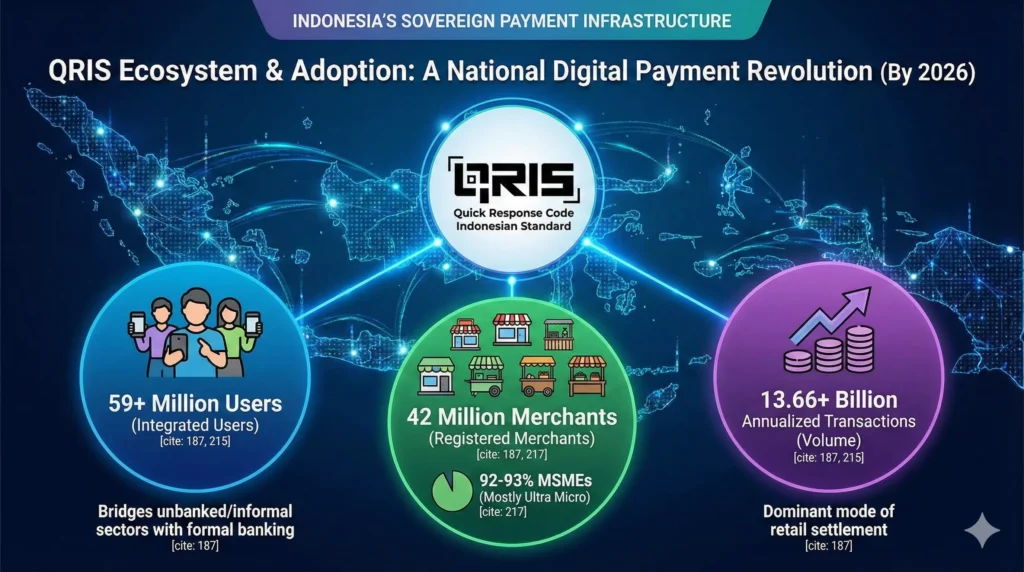
The quantitative expansion of the QRIS ecosystem has defied all initial adoption curves, exhibiting a geometric growth rate that signals a fundamental shift in the behavioral economics of the Indonesian population. By the close of 2025, the system had registered approximately 59 million unique active users, surpassing the central bank’s target of 55 million and penetrating deeply into demographic segments previously considered resistant to digital banking. The user base is heavily skewed toward the “digital native” demographics, with Generation Z and Millennials accounting for a significant plurality of transactions, yet data from 2025 indicates a rapidly closing gap among older demographics, driven by the necessity of QRIS for essential utility payments and social assistance disbursements. The transaction volume for the full year 2025 reached an unprecedented 13.66 billion, a figure that dwarfs the combined volume of credit and debit card transactions in the country and reflects the high-frequency nature of QRIS usage for micro-transactions such as street food, parking fees, and small retail purchases.
The supply side of the market is characterized by a “long tail” distribution of merchants. Of the 42 million registered QRIS merchants as of late 2025, approximately 92-93% are classified as Micro, Small, and Medium Enterprises (MSMEs), with the vast majority falling into the “Ultra Micro” (UMI) category. These are entities with annual turnovers of under Rp 300 million, often operating in the informal economy without formal business licenses or tax identification numbers prior to their onboarding. The integration of these 39 million+ micro-merchants into the formal financial system represents a massive expansion of the addressable market for financial services, providing banks with granular cash-flow data that can be utilized for alternative credit scoring. However, this demographic skew also presents a profitability challenge; the average ticket size (ATS) for QRIS transactions remains significantly lower than card transactions, meaning that while the volume is immense, the value-based revenue pool is fragmented across billions of tiny transactions that carry the same per-unit processing cost as larger payments.
Geographically, the adoption of QRIS initially mirrored the economic concentration of the archipelago, with Jakarta, West Java, and East Java accounting for the lion’s share of merchant density and transaction value. However, adoption trends in 2024 and 2025 have shown a decisive shift toward decentralization. Growth rates in “Outer Java” regions have consistently outpaced the national average, with provinces such as Kalimantan recording 24% year-on-year growth and the Sulawesi-Maluku-Papua corridor also showing robust expansion. This dispersion is highly correlated with the aggressive rollout of 4G telecommunications infrastructure under the government’s Palapa Ring project (see $TLKM), which has brought reliable mobile internet to remote regions, removing the primary infrastructural barrier to digital payment adoption. The ubiquity of QRIS in these regions has begun to alleviate the chronic “cost of cash” issues faced by the central bank, reducing the logistical burden of physically distributing banknotes to remote islands and lowering the operational risks for merchants who no longer need to hoard physical cash.
| Region | Merchant Growth Rate (2025) | Key Drivers |
|---|---|---|
| Java (Jakarta, West, East) | ~12-15% | Saturation in urban centers; shift to modern retail & transit. |
| Sumatra | 19% | Commodity boom effects; tourism in North Sumatra. |
| Kalimantan | 24% | Development of new capital city (IKN); infrastructure spend. |
| Sulawesi-Maluku-Papua | 24% | Mining sector liquidity; Palapa Ring connectivity. |
| Bali-Nusa Tenggara | 16% | Tourism recovery; cross-border QR integration. |
The Economics of Acceptance: Merchant Discount Rates (MDR) and Banking Revenue Shifts
The economic viability of the QRIS ecosystem for acquirers and issuers hinges on the Merchant Discount Rate (MDR) policy, which has been a subject of intense regulatory calibration and political sensitivity. In the initial rollout phase, Bank Indonesia mandated a 0% MDR for the Ultra Micro (UMI) segment to eliminate the financial friction of adoption, effectively subsidizing the network’s growth through the balance sheets of the acquiring banks. However, recognizing the unsustainability of a zero-revenue model for infrastructure providers, the regulator adjusted the rate to 0.3% in mid-2023 for micro-businesses, a move that sparked significant backlash from small merchant associations who operated on razor-thin margins. In response to these concerns and to support the purchasing power of the lower-middle class, Bank Indonesia revised the policy again in late 2024, reinstating the 0% MDR for transactions under Rp 500,000 for UMI merchants, while maintaining the 0.3% rate for transactions exceeding this threshold. For larger enterprises (UKE, UME, UBE), the rate is capped at 0.7%, which is still significantly lower than the 1.5% – 2.5% effective rates typically charged by credit card schemes.
This compressed pricing structure has profound implications for the revenue models of Indonesian banks. Historically, banks relied on significant Fee-Based Income (FBI) generated from card interchange fees, annual fees, and EDC rental charges. The shift toward QRIS represents a form of revenue “cannibalization,” where high-margin card transactions are replaced by low-margin or loss-leading QR transactions. While the volume of transactions has exploded, the direct revenue per transaction has collapsed. Consequently, banks such as Bank Rakyat Indonesia ($BBRI) and Bank Mandiri ($BMRI) have been forced to pivot their strategic focus from direct monetization of payments to the “financialization” of the merchant relationship.
Comparison chart of BBRI, BMRI, BBCA, BBNI with timeframe 1 Year.
The primary value of processing QRIS transactions for a bank is no longer the transaction fee itself, but the acquisition of cheap, stable low-cost deposits (Current Account Savings Account – CASA) that the merchant maintains to receive settlements. By capturing the merchant’s operating cash flow, banks can reduce their cost of funds and improve their Net Interest Margin (NIM). Additionally, the transactional data harvested from QRIS flows allows banks to offer pre-approved micro-loans and working capital facilities (Buy Now Pay Later for business) with much lower customer acquisition costs and risk profiles than traditional lending models.
Furthermore, the MDR policy is structured to incentivize specific socio-economic activities. For instance, transactions related to education are capped at a preferential 0.6%, while Government-to-People (G2P) social aid disbursements and People-to-Government (P2G) tax payments are set at 0%, reinforcing the state’s intent to use QRIS as a frictionless channel for fiscal administration. This tiered pricing strategy effectively turns the payment system into an instrument of fiscal policy, allowing the government to subsidize essential sectors while extracting value from commercial consumption. The tension between the banks’ need for profitability to sustain infrastructure investment and the government’s mandate for low-cost financial inclusion remains a dynamic friction point, likely to result in further calibrations of the MDR structure as the market matures and the dominance of the platform becomes entrenched.
Behavioral Economics: Consumer Preference and the Psychology of “Pay by HP”
The widespread preference for QRIS among Indonesian locals over cash and cards is driven by a unique confluence of User Experience (UX) design, economic incentives, and cultural adaptation. Psychologically, the “Pay by HP” (Handphone) phenomenon aligns perfectly with the country’s “mobile-first” internet culture, where smartphone penetration exceeds bank account penetration. For the average Indonesian consumer, the smartphone is the primary repository of identity and wealth; accessing funds via a biometric scan on a phone feels more secure and personal than carrying a physical card which is susceptible to skimming. The friction of the payment process has been reduced to a matter of seconds, and the instant notification of success provides a dopamine hit and a sense of immediate financial closure that is absent in delayed-posting credit card transactions. Furthermore, the specific design of the QRIS flow—which often requires the user to input the amount (in static MPM) or simply confirm it—gives the user a sense of control and agency over the payment push, contrasting with the “pull” mechanic of card payments where the merchant controls the terminal.
Behavioral research indicates that the “perceived ease of use” and “social influence” are the two strongest predictors of QRIS adoption in Indonesia. The social aspect is particularly potent; the ubiquity of the QRIS logo at every warung, roadside stall, and mall creates a “network effect of trust,” where the presence of the logo signals that a merchant is modern, legitimate, and safe. For Generation Z and Millennials, who constitute the bulk of the user base, the social stigma associated with fumbling for cash or waiting for change has been replaced by the social proof of seamless digital interaction. This demographic is also highly sensitive to the “gamification” of payments employed by issuer wallets, where QRIS transactions are often rewarded with points, cashback, or randomized discounts, turning the mundane act of payment into a potentially rewarding engagement.
Moreover, the preference is reinforced by the “zero-cost” nature of the transaction for the consumer. Unlike bank transfers which often incurred a Rp 6,500 fee prior to BI-FAST, or debit card usage which sometimes attracted illicit surcharges from merchants, QRIS is universally free for the payer. The transparency of the system—where the exact amount is debited without hidden fees—builds trust in a low-trust society. Even the shift to digital donations (zakat and sedekah) via QRIS at mosques and charities has accelerated adoption, leveraging religious and cultural obligations to drive technological habituation. This cultural integration is a critical factor in why QRIS has succeeded where other technocratic solutions failed; it successfully embedded itself into the existing cultural rituals of commerce and community rather than trying to replace them entirely.
Infrastructural Evolution: From Static Stickers to NFC “Tap” Integration
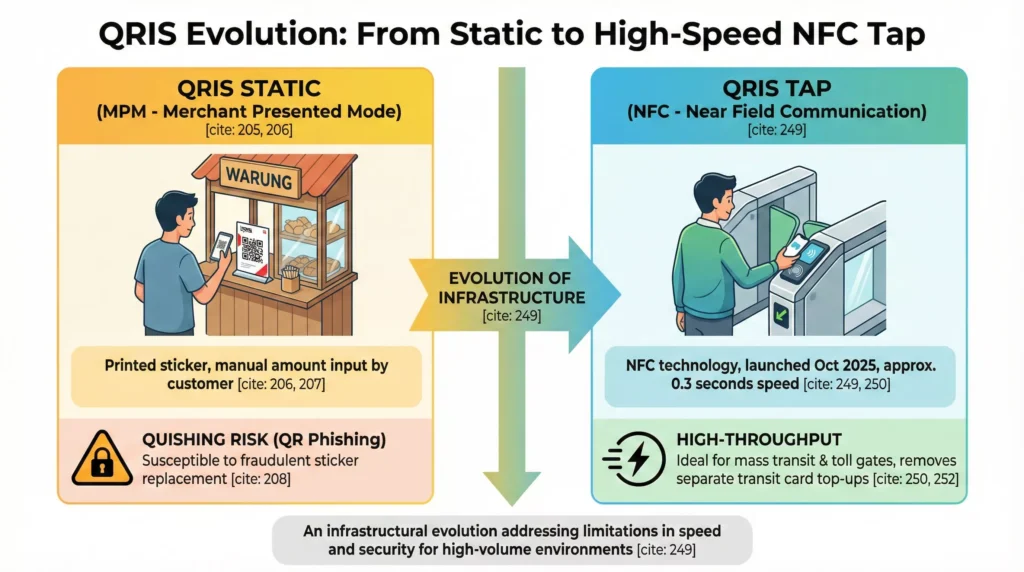
While the static QR code was the catalyst for mass adoption, its inherent limitations in speed and security have necessitated an infrastructural evolution toward Near Field Communication (NFC) technology, realized in the launch of “QRIS Tap” in October 2025. The static QR code, relying on optical recognition, requires a stable internet connection, adequate lighting conditions, and a steady hand to focus the camera—variables that create unacceptable latency in high-throughput environments like mass transit turnstiles or toll gates. The QRIS Tap initiative addresses these physical constraints by allowing users to simply tap their smartphone against a reader, executing the transaction via NFC in approximately 0.3 seconds, a speed comparable to closed-loop transit cards. This development is not merely a technical upgrade but a strategic encroachment into the “closed loop” transit payment market previously dominated by bank-issued e-money cards (e.g., Flazz, E-Money, Brizzi).
The rollout of QRIS Tap has been aggressive, with the service available in 14 provinces by early 2026 and integrated into major transit arteries such as the MRT Jakarta, TransJakarta, and KRL Commuter lines. The initial adoption data is staggering, with transaction volumes surging 1,200% month-on-month to reach 508,000 transactions shortly after launch, indicating substantial pent-up demand for a unified transit payment solution that does not require the separate top-up of a physical card. This innovation effectively removes the “double balance” inefficiency where users had to maintain funds in their bank account and separate funds on their transit card. With QRIS Tap, the transit fare is deducted directly from the source of funds (bank account or server-based wallet), streamlining the user’s liquidity management.
However, this technological leap introduces new hardware dependencies. Unlike the optical QR code which is software-agnostic, NFC functionality requires specific hardware support on the user’s device and the merchant’s terminal. While Android support was available at launch, the integration with Apple’s iOS—which has historically restricted third-party access to the NFC controller—remains a critical hurdle for capturing the affluent segment of the market. Bank Indonesia’s roadmap includes ongoing negotiations to expand compatibility to iOS devices, recognizing that full ubiquity is impossible without covering the iPhone user base. Additionally, the deployment of NFC-enabled readers represents a higher capital expenditure for acquirers compared to printing paper stickers, suggesting that QRIS Tap will likely remain concentrated in the “Tier 1” merchant segment (transit, modern retail, parking) while the static QR code remains the standard for the “Tier 3” micro-merchant segment, creating a bifurcated but interoperable infrastructure.
Cross-border Connectivity and the Geopolitics of Regional Settlement
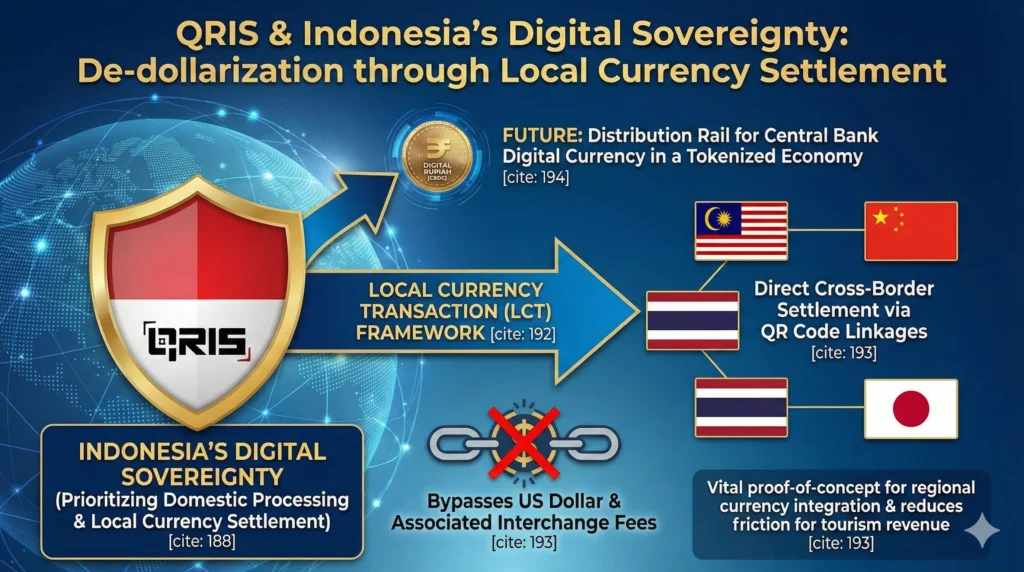
The ambition of QRIS extends well beyond domestic borders, serving as the spearhead for Indonesia’s regional financial diplomacy and the practical application of the Local Currency Transaction (LCT) framework. By 2025, Bank Indonesia had successfully operationalized bilateral cross-border QRIS linkages with Malaysia, Thailand, and Singapore, creating a seamless payment corridor for the ASEAN-5 economies. These linkages function by interconnecting the national switching infrastructures—such as connecting Indonesia’s Jalin/Rintis to Malaysia’s PayNet and Thailand’s NITMX—allowing a user to scan a foreign QR code while the backend settles the transaction through direct central bank currency swap arrangements. This mechanism explicitly bypasses the US Dollar as an intermediary settlement currency, thereby reducing the “double conversion” spread (IDR -> USD -> THB) and shielding the retail tourism economy from USD exchange rate volatility.
Candlestick chart of US Dollar to Indonesian Rupiah (RUPIAH) with timeframe 1 Year.
The statistical performance of these corridors reveals the strong economic ties within the region. In 2025, the Indonesia-Malaysia corridor emerged as the highest volume link, with inbound transactions (Malaysian tourists in Indonesia) exceeding 3.4 million and outbound transactions reaching 516,000. This asymmetry highlights QRIS’s potent role as an export earner; by making it easier for regional tourists to spend their home currency in Indonesia, the system effectively lowers the friction for tourism service exports. The expansion roadmap is aggressive, with live integration already established with Japan and advanced technical pilots underway with China and South Korea. The China linkage is particularly significant and technically complex, as it involves harmonizing the QRIS standard with the massive, proprietary ecosystems of Alipay and WeChat Pay, which dominate the spending of the largest tourist demographic in Asia. Furthermore, the planned expansion to Saudi Arabia aims to capture the enormous volume of Hajj and Umrah spending, potentially allowing millions of Indonesian pilgrims to pay for expenses in the Holy Land using Rupiah-denominated wallets, a move that would significantly ease the seasonal demand for physical Riyals.
At the multilateral level, Indonesia is a key participant in “Project Nexus,” an initiative led by the Bank for International Settlements (BIS) Innovation Hub to create a standardized global platform for cross-border fast payments. Moving into Phase 4 in 2025/2026, Project Nexus aims to replace the “spaghetti bowl” of bilateral links with a single “hub-and-spoke” model, where each country connects once to the Nexus Scheme Organization (NSO) to gain access to all other participants. Indonesia holds “special observer” status in this phase, positioning itself to join the live network which initially includes Malaysia, the Philippines, Singapore, Thailand, and India. This project represents a fundamental challenge to the established order of cross-border remittances, threatening to disintermediate the SWIFT network and the correspondent banking model for low-value retail transfers by offering near-instant settlement at a fraction of the cost.
Strategic Friction: the Ustr Trade Barrier Designation and Global Card Networks
The rapid ascent of QRIS as a sovereign payment rail has not occurred without geopolitical friction. The United States Trade Representative (USTR), in its 2025 National Trade Estimate Report on Foreign Trade Barriers, explicitly classified Indonesia’s QRIS and National Payment Gateway (GPN) policies as technical barriers to trade. The U.S. objection centers on two primary issues: market access and procedural transparency. Firstly, the requirement for all domestic retail transactions to be processed via local switching institutions effectively prevents global networks like Visa and Mastercard from leveraging their centralized global processing hubs, forcing them to integrate with local switches and thereby diluting their control over the transaction value chain. Secondly, the USTR argues that the standard-setting process for QRIS was opaque and exclusionary, with foreign stakeholders not adequately consulted before the imposition of technical specifications that deviated from global norms.
This designation of QRIS as a trade barrier highlights the growing politicization of payment infrastructure. The U.S. views the “sovereign stack” model championed by Indonesia—and echoed by Brazil’s PIX and India’s UPI—as a form of digital protectionism that unfairly advantages domestic players at the expense of American multinational corporations. However, Bank Indonesia and the Ministry of Trade have staunchly defended the policy, arguing that control over the national payment system is a matter of financial stability and sovereignty that cannot be outsourced. Officials have emphasized that foreign players are not banned but must adhere to domestic rules, citing the continued presence of Visa and Mastercard in the credit card segment as evidence of an open market. The Indonesian government’s stance is that the “localization” of payments is necessary to ensure that the data generated by Indonesian citizens remains under national jurisdiction and that the fees generated contribute to the development of the local financial infrastructure rather than being repatriated abroad.
Despite the diplomatic tension, the market reality is one of segmentation rather than total displacement. Visa and Mastercard continue to dominate the high-value, corporate, and international travel segments where their credit facilities, fraud protection, and global acceptance offer superior value. However, in the high-frequency, low-value debit segment, QRIS has undeniably eroded their market share, serving as a functional substitute for debit cards. The global networks have responded by seeking integration, enabling their cards to act as funding sources for QRIS transactions and partnering with local wallets, effectively acknowledging that in the Indonesian retail context, the QR code has won the war for the “last inch” of the transaction.
Future Horizons: Project Nexus, Digital Rupiah, and the 2030 Blueprint
Looking toward the horizon of 2030, the trajectory of QRIS is codified in the Indonesia Payment System Blueprint (BSPI 2030), which envisions the system evolving from a mere payment tool into a comprehensive platform for the digital economy. A central pillar of this future state is the “17-8-45” strategy announced for 2026, which sets ambitious targets of 17 billion transactions, expansion to 8 cross-border partner countries, and a merchant network of 45 million. This strategy underscores the central bank’s intent to push the boundaries of saturation, ensuring that digital payments become the default medium of exchange even in the most remote corners of the archipelago.
The most transformative development on the roadmap is the integration of QRIS with Project Garuda, Indonesia’s initiative to issue a Digital Rupiah. The blueprint indicates that the retail Central Bank Digital Currency (r-Rupiah) will leverage the existing QRIS acceptance network for distribution and transaction processing. This “backward compatibility” is strategically vital; it means that when the Digital Rupiah is launched, it will immediately be usable at 45 million merchant locations without the need for new hardware. QRIS will effectively serve as the “last mile” infrastructure for the CBDC, bridging the gap between the programmable money of the future and the street-side warung of today. This convergence will allow for highly programmable fiscal transfers, such as targeted social subsidies that can only be spent at specific merchants via QRIS, ensuring zero leakage and precise economic impact.
Furthermore, the cybersecurity resilience of the ecosystem will be a primary focus of the 2026-2030 period. With the rise of “quishing” attacks and the centralization of transaction data, the system faces systemic risks that require “military-grade” defense mechanisms. The blueprint calls for the implementation of AI-driven fraud detection systems at the network level and stricter biometric authentication standards for dynamic QR generation. Ultimately, the vision for QRIS is to become an invisible, ubiquitous utility—like electricity or the internet—that powers the Indonesian economy, fully sovereign in its operation, integrated globally on its own terms, and resilient enough to support the nation’s ascent to a top-tier global economy by 2045.
Statistical Appendix: Key Performance Indicators (As of Feb 2026)
| Metric | Value / Status |
|---|---|
| Total Registered Users | ~59 Million |
| Total Merchant Network | 42 Million (93% MSMEs) |
| Annual Transaction Volume (2025) | 13.66 Billion |
| 2026 Volume Target | 17 Billion |
| Cross-Border Leader | Malaysia (~3.4M inbound tx/year) |
| QRIS Tap Adoption | 508,000 transactions (post-launch) |
| Merchant Discount Rate (UMI) | 0% ( |
Disclaimer: This material is for informational purposes only. It is not intended as financial advice or a solicitation to buy or sell securities. Past performance is not indicative of future results.
Disclaimer
aluna Analytics is an independent research collective that operates without affiliation to any financial institution, broker, or advisory firm. We do not hold licenses as a securities dealer, investment advisor, or portfolio manager.
All materials published by aluna Analytics are created solely for informational and educational purposes. They reflect independent analytical interpretation and should not be regarded as personalized investment advice, solicitation, or endorsement of any security or strategy.
Market data, opinions, and projections presented herein are subject to change and may not predict future results. Readers remain fully responsible for any financial decisions made based on the information provided. We strongly encourage conducting personal due diligence and consulting a licensed professional before making investment commitments.
aluna Analytics is not regulated by the Financial Services Authority of Indonesia (OJK) and does not offer investment management or brokerage services. All content is presented in good faith, aiming to foster research literacy and informed market perspectives.