


Author: aluna Analytics | Date: July 1, 2025 | Sector: Basic Materials / Containers & Packaging | Recommendation: Neutral (Long-Term Fundamental) / Subscribe (Short-Term Trading Momentum)
The listing of PT Asia Pramulia Tbk (“ASPR” or “the Company”) on the Indonesia Stock Exchange (IDX) on July 8, 2025, represents a pivotal development within the domestic rigid plastic packaging sector. By offering 812 million new common shares at a fixed price of IDR 124 per share, the Company successfully mobilized approximately IDR 100.68 billion in fresh capital. This transaction implies a post-money market capitalization of roughly IDR 336.29 billion, positioning $ASPR as a nimble, small-cap contender in a market dominated by multi-trillion Rupiah conglomerates like Impack Pratama Industri Tbk ($IMPC) and Panca Budi Idaman Tbk ($PBID).
The offering, which was oversubscribed by 1.53 times, underscores a calibrated market appetite. While not indicative of the euphoric demand often seen in technology or digital banking listings, this level of oversubscription reflects a pragmatic recognition of the Company’s tangible asset base and the defensive nature of the consumer packaging industry. The IPO proceeds are strategically earmarked to address an immediate and critical operational constraint: production capacity. With approximately 50% of funds allocated to capital expenditure for advanced machinery and the remaining 50% directed toward working capital for raw material procurement, the issuance is fundamentally a “debottlenecking” event designed to unlock suppressed growth potential.
From a valuation standpoint, the Company enters the public domain with demanding multiples. The IPO price of IDR 124 implies a trailing Price-to-Earnings (PER) ratio of approximately 45.02x based on FY2024 earnings and a Price-to-Book Value (PBV) of 3.25x. This pricing structure places $ASPR at a significant premium relative to established industry peers such as $PBID, which trades at a PER of approximately 9.16x and a PBV of 1.29x. This valuation disparity suggests that the market—and the underwriters—are pricing the stock not on its historical performance, but on a forward-looking execution thesis that assumes aggressive double-digit growth in 2025 and 2026 driven by the new capacity.
ASPR
PT Asia Pramulia TbkDisclaimer: This research report is produced by aluna Analytics for informational and educational purposes only. It does not constitute a recommendation to buy or sell any securities. Market data is analyzed as of July 1, 2025. Investors should conduct their own due diligence and consult with a certified financial advisor before making investment decisions.
The investment thesis for the Company is predicated on three pillars: the resilience of domestic consumption in the food and beverage (F&B) sector, the Company’s strategic shift toward higher-margin manufacturing technologies like In-Mold Labeling (IML), and the potential for operational leverage as production scales. However, this thesis is counterbalanced by significant structural risks, including exposure to volatile crude oil prices (which dictate resin costs), intense competition from larger economies of scale, and the execution risk inherent in ramping up new industrial capacity. For short-term market participants, the involvement of PT NH Korindo Sekuritas Indonesia as the lead underwriter signals a likelihood of high initial volatility and trading momentum, characteristic of their historical management of small-cap issuances.
IPO Deal Mechanics and Structural Dynamics
A granular analysis of the IPO structure reveals the specific mechanisms designed to balance capital influx with shareholder retention, as well as the regulatory framework governing the listing.
The Offering Structure
The IPO is characterized by a 100% Primary Issuance, a structural feature that is highly favorable for incoming minority shareholders. Unlike “mixed” offerings where existing shareholders use the IPO as an exit liquidity event, the issuance of 812 million new shares ensures that the entire gross proceeds of IDR 100.68 billion flow directly into the Company’s equity base. This capital injection effectively doubles the Company’s pre-IPO equity, significantly altering its capital structure and providing the liquidity runway necessary for its expansion roadmap.
| Deal Metric | Specification | Strategic Implication |
|---|---|---|
| Ticker Symbol | ASPR | Listed on the IDX Development Board (Papan Pengembangan) due to asset scale. |
| IPO Price | IDR 124 | Priced at the upper bound of the IDR 118 – IDR 124 book-building range, indicating that institutional and retail demand remained robust even at the maximum valuation. |
| Total Shares Offered | 812,000,000 | Represents a public float of 29.94% of the enlarged share capital. This relatively high float (compared to the 7.5% minimum) is designed to foster secondary market liquidity. |
| Gross Proceeds | IDR 100.69 Billion | Classified as a small-scale offering, suitable for boutique asset managers and retail traders rather than large-cap global funds. |
| Nominal Value | IDR 25 per share | A standard nominal value for this market capitalization tier, facilitating a psychological “low price” entry point for retail investors. |
| Oversubscription | 1.53x | The ratio indicates a healthy but balanced order book. It suggests that while the issue was fully covered, there was not an overwhelming “scarcity effect,” which can sometimes lead to unsustainable Day 1 price spikes followed by rapid corrections. |
| Warrants | None | The omission of Series I Warrants is a signal of underwriter confidence. Warrants are often attached to small-cap IPOs as a “sweetener” to compensate investors for risk. Their absence implies the equity story was compelling enough to stand alone. |
Shareholder Ecosystem and Lock-Up Provisions
The post-IPO capital table reflects a continued concentration of ownership among the founding entities, ensuring management stability. The primary shareholders—Alex Yoe, Susan Yoewono, and Ricky Winoto—retain the majority controlling interest.
Regulatory Lock-Up Context: Under Otoritas Jasa Keuangan (OJK) Regulation No. 25/POJK.04/2017, pre-IPO shareholders who acquired equity at a price below the IPO offering price within six months prior to the registration statement are mandatorily prohibited from selling their shares for eight months post-listing. Given that the founding shareholders have held their positions since the company’s establishment in 1991 (or significantly prior to the six-month window), the mandatory regulatory lock-up might technically apply differently depending on any recent capital restructuring. However, in standard IDX practice for Main and Development board listings, controlling shareholders typically agree to a voluntary lock-up period (often 6 to 12 months) to signal commitment and prevent supply shock. The prospectus confirms that the founders are committed to the business, and no divestment (secondary offering) occurred during the IPO, reinforcing the alignment of interests with public investors.
The Underwriting Consortium
The composition of the underwriting syndicate provides critical clues regarding the expected trading behavior of the stock.
Lead Underwriter: PT NH Korindo Sekuritas Indonesia (XA)
NH Korindo is a prominent player in the Indonesian mid-cap IPO space. Their track record is characterized by listings that often experience significant volatility in the early trading sessions. Historical data indicates that stocks underwritten by XA, such as Adaro Minerals ($ADMR), have demonstrated the potential for massive capital appreciation, driven by aggressive market-making and strong retail distribution networks. However, this high-beta characteristic also implies a risk of sharp corrections if market sentiment shifts.
Co-Underwriter: PT Panca Global Sekuritas (PG)
Serving as a supporting underwriter, Panca Global brings additional distribution capabilities, particularly among domestic retail investors. Their involvement complements XA’s strategy, ensuring widespread dispersal of the 29.94% public float to minimize concentration risk among flippers.
Corporate Profile
Operational History and Evolution
Founded in 1991 in Surabaya, East Java, PT Asia Pramulia Tbk has navigated over three decades of Indonesia’s industrial evolution. Unlike digital startups that burn cash to acquire users, $ASPR is a legacy manufacturer with tangible assets and long-standing B2B relationships. The transition to a public entity in 2025 marks a strategic inflection point: moving from a conservative, family-run operation to a transparent, capital-market-funded industrial player.
Manufacturing Footprint and Technology
The Company operates two distinct production facilities in East Java, a region that serves as a critical industrial hub for Eastern Indonesia.
- Surabaya Plant (Main Hub): This facility is the operational heart of the company. It houses 23 injection molding units and 24 blow molding units. A key technological differentiator here is the deployment of 4 robotic In-Mold Labeling (IML) units. IML is a process where a pre-printed polypropylene (PP) label is placed into a mold before the molten plastic enters. The label fuses with the plastic as it hardens, becoming an integral part of the product. This contrasts with traditional adhesive labeling, which is applied post-production. IML offers superior durability, hygiene (no adhesives), and aesthetic quality, allowing the Company to command higher margins in premium segments like ice cream containers and high-end paints.
- Pasuruan Plant (Secondary Hub): Located in Beji, Pasuruan, this smaller facility operates 3 injection molding and 3 blow molding machines. Its geographic proximity to key industrial estates allows it to serve specific regional clients with lower logistics costs, providing redundancy and specialized capacity.
Product Segmentation and Market Positioning
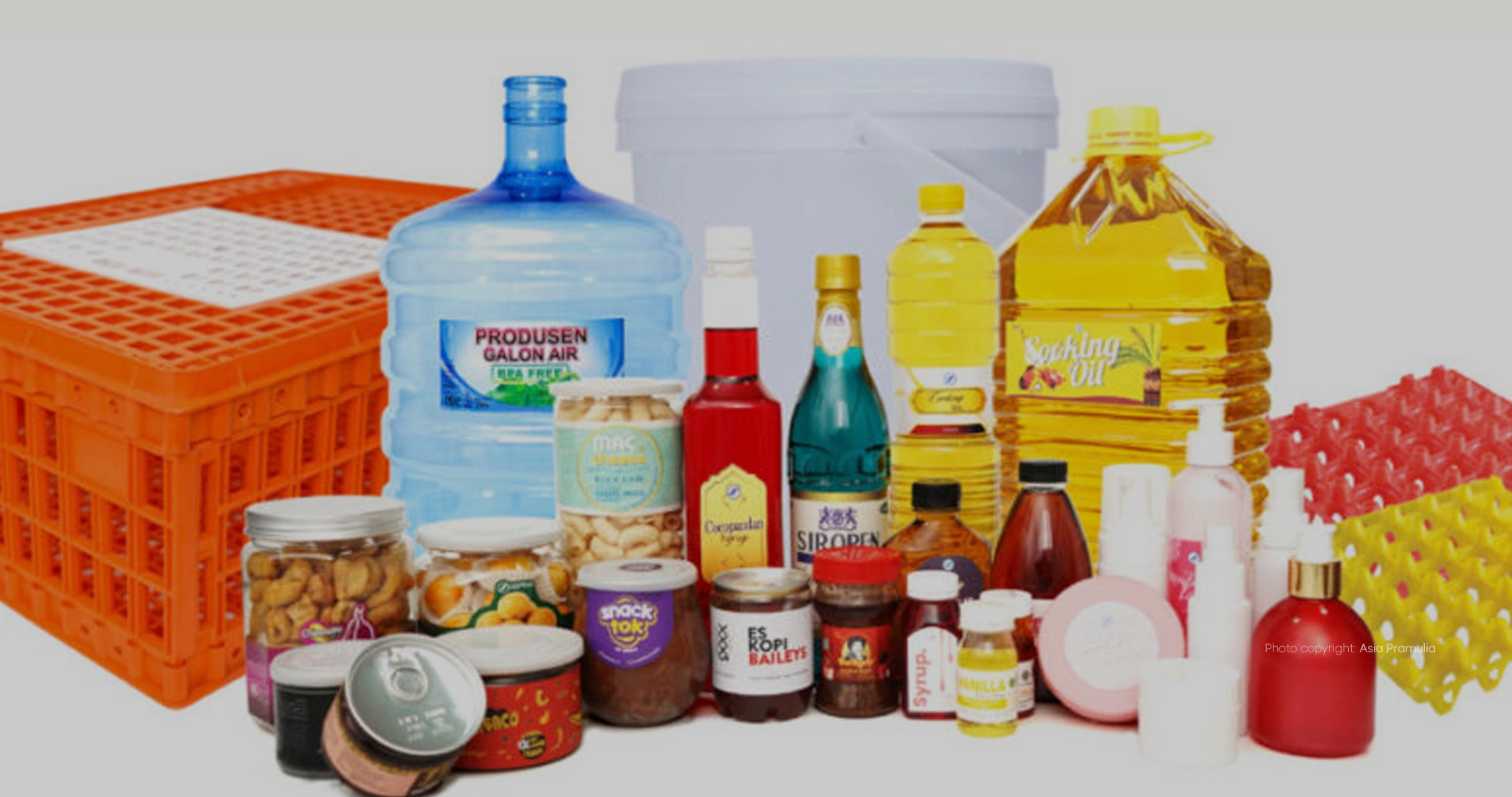
Operating strictly within the Rigid Plastic Packaging sub-sector, the Company’s product portfolio is diversified across several end-use industries, reducing reliance on any single sector cyclicality.
- Beverage Sector (AMDK & Juices): The company manufactures PET bottles and closures for Air Minum Dalam Kemasan (AMDK) and flavored drinks. This is a high-volume segment driven by population growth and the tropical climate.
- Food & Confectionery: Production of jars, containers for biscuits, and bakery products. This segment demands food-grade certification (ISO 9001:2015, FSSC 22000) and aesthetic appeal for retail shelf presence.
- Industrial & Chemical: Manufacturing of jerry cans and durable containers for paints, lubricants, and agricultural chemicals. This segment prizes durability and chemical resistance over aesthetics.
- Pharmaceuticals: A niche but high-value segment producing bottles for liquid medicines and tablets, requiring stringent hygiene standards.
The Strategic Necessity of the IPO: The most revealing insight from the IPO disclosure is the company’s admission regarding its production limitations. Management explicitly stated that pre-IPO raw material stocks were “only sufficient for existing capacity” and that the IPO proceeds were critical to “purchase new machines and additional raw materials”. This indicates that the Company was operating at a capacity ceiling. The IPO, therefore, is not merely for “general corporate purposes” but is a targeted strike to debottleneck operations and capture immediate, pent-up demand.
Industry Analysis: The Indonesian Packaging Landscape
Macroeconomic Drivers: The 2025-2030 Outlook
The Indonesian rigid plastic packaging market is forecasted to expand at a Compound Annual Growth Rate (CAGR) of approximately 4.98% to 6.65% between 2025 and 2030. Several macroeconomic vectors underpin this growth: the demographic dividend and urbanization, the “Free Nutritious Meals” program which creates a baseline for food-grade containers, and the booming E-Commerce logistics sector that requires robust packaging.
Competitive Landscape and Peer Benchmarking
The Company competes in a fragmented tier below the market giants. Understanding its position relative to listed peers is crucial for valuation context.
Comparison chart of IMPC, PBID, SMKL, IGAR with timeframe 1 Year.
Impack Pratama Industri Tbk ($IMPC): The market bellwether. IMPC is a giant with a market cap exceeding IDR 20 trillion. It trades at a premium due to its dominant market share and diverse product mix.
Panca Budi Idaman Tbk ($PBID): The value leader. PBID dominates the plastic bag and flexible packaging market. It typically trades at very attractive multiples and offers a high dividend yield.
Satyamitra Kemas Lestari Tbk ($SMKL): Primarily a carton box manufacturer for clients like Unilever. SMKL serves as a proxy for general FMCG packaging demand.
Champion Pacific Indonesia Tbk ($IGAR): Specializes in flexible packaging for the pharmaceutical industry, known for its steady, defensive business model.
Strategic Insight: $ASPR is attempting to position itself in a valuation bracket (PER 45x) that is significantly higher than established cash cows like $PBID. This implies the market is assigning a substantial “scarcity premium” or “growth premium” to the Company, betting that its smaller size will allow it to compound earnings much faster than its mature peers.
Financial Deep Dive: Forensics and Future Outlook
A critical examination of the financials reveals the logic behind the high IPO valuation and the risks associated with it.
Historical Performance and the “Turnaround”
For the fiscal year 2024, the Company reported revenue of approximately IDR 209.1 billion and a net profit of IDR 5.4 billion. This translates to a Net Profit Margin (NPM) of roughly 2.58%. A 2.6% net margin is razor-thin, even for a manufacturing business. In comparison, peers like $PBID often sustain net margins in the 7-10% range. This disparity suggests that pre-IPO, the Company suffered from operational inefficiencies, high interest burdens from debt, or a lack of pricing power due to capacity constraints.
The Q2 2025 Inflection: Post-IPO disclosures indicate a sharp uptick in performance. For the second quarter of 2025 alone, the Company reported a net profit of IDR 3.2 billion. If the company can sustain this IDR 3.2 billion quarterly performance, the annualized net profit for 2025 would approach IDR 12.8 billion, representing a >135% increase year-over-year compared to FY2024. While the trailing PER at IPO is expensive (~45x), the forward PER based on this annualized run-rate drops to approximately 26x.
Balance Sheet Transformation
The IPO is a massive recapitalization event for $ASPR. With pre-IPO equity of approximately IDR 72.5 billion, the capital injection of IDR 100.68 billion (gross) means the equity base has effectively more than doubled to an estimated IDR 170 billion – IDR 176 billion. This massive injection of unlevered capital drastically reduces the Debt-to-Equity (DER) ratio. By using IPO proceeds for working capital instead of high-interest bank loans, the Company will see an immediate reduction in interest expenses, which directly accretes to the bottom line.
Use of Proceeds: A Strategic Blueprint
The allocation of the IDR 100.68 billion raised is precise and reveals management’s immediate priorities.
- 50% for Capital Expenditure (Capex) (~IDR 50 Billion): Deployment includes the purchase of new injection and blow molding machinery, molds, and auxiliary utilities, specifically for beverage, food, paint, and pharmaceutical packaging. Since machinery typically has a lead time of 6-12 months, the revenue impact of this capex will likely start materializing in late 2025 and ramp up fully in 2026. Investors buying today are paying for 2026 capacity.
- 50% for Working Capital (Opex) (~IDR 50 Billion): Used for procurement of raw materials (PET, PP resin) and funding operational costs. This injection allows the Company to buy resin in larger quantities to secure volume discounts, hold more stock to hedge against price spikes, and fulfill larger orders immediately in Q3 and Q4 2025.
Valuation Analysis and Peer Comparison
Valuation remains the most contentious aspect of the investment case.
| Metric | ASPR (IPO) | PBID (Panca Budi) | IMPC (Impack) | SMKL (Satyamitra) |
|---|---|---|---|---|
| Price (Reference) | IDR 124 | ~IDR 488 | ~IDR 3,940 | ~IDR 170 |
| PER (Trailing) | 45.02x | 9.16x | ~25-30x | ~27-32x |
| PBV (Price/Book) | 3.25x | 1.29x | ~3-4x | ~0.6x |
| ROE | ~2.6% (Pre-IPO) | ~14.5% | ~15-20% | ~2% |
| Market Cap | IDR ~336 B | IDR ~3.6 T | IDR ~20 T | IDR ~1.8 T |
| Dividend Yield | N/A (Growth) | ~7-11% | ~1-2% | ~1-2% |
A 45x PER for a commoditized manufacturing business is objectively expensive. It is nearly 5x the valuation of $PBID. However, the market is betting that historical earnings are a depressed baseline. If the “turnaround” thesis holds and earnings hit IDR 15 billion, the PER compresses to ~22x. A 3.25x PBV is very high for a low-ROE industrial firm, implying the market believes the book value of the assets significantly understates their earnings generation potential, or that the new capital will generate returns on equity far exceeding the cost of capital.
Risk Assessment
Volatility of Raw Materials (High Severity): Resin costs constitute 60-70% of COGS. A geopolitical event driving oil to $100/barrel would severely compress margins, especially if demand is elastic and prices cannot be passed on.
Execution Risk (Medium Severity): The “growth” thesis relies on the seamless installation and utilization of new machines. Delays in shipping, technical glitches, or a failure to secure orders to fill that new capacity would leave the company with higher depreciation costs but no matching revenue.
Liquidity and Market Risk (Medium Severity): As a small-cap stock on the Development Board, the stock risks falling off the radar of institutional investors. If daily trading volume dries up, retail investors may find themselves trapped in an illiquid position with wide bid-ask spreads.
Regulatory Headwinds (Low to Medium Severity): The Indonesian government’s push to reduce plastic waste and the potential implementation of a plastic excise tax (cukai plastik) pose a long-term structural threat.
Conclusion and Recommendation
PT Asia Pramulia Tbk ($ASPR) is a classic “small-cap growth” play masquerading as a boring industrial stock. The company has utilized the capital markets to double its equity base and break through a hard capacity ceiling. The Q2 2025 financial results provide the first evidentiary support for the “turnaround” thesis, suggesting that the aggressive valuation might be justified by future earnings growth. However, the valuation leaves zero margin for error. At 45x trailing earnings, the stock is priced for perfection. Any stumble in execution, any delay in machinery arrival, or any sustained spike in oil prices could cause the stock to re-rate rapidly downward toward the multiples of its peers.
For the Agile Trader
Recommendation: SUBSCRIBE / BUY. The combination of a small nominal price (IDR 124), a modest issue size (IDR 100B), and a high-beta underwriter (NH Korindo) creates a favorable setup for short-term volatility and momentum trading. The “turnaround” narrative provides enough fuel for a speculative rally.
For the Fundamental Investor
Recommendation: NEUTRAL / MONITOR. The risk-reward ratio at IDR 124 is not compelling for a buy-and-hold strategy yet. The premium over $PBID is too difficult to ignore. Fundamental investors should wait for the Q3 and Q4 2025 reports to confirm that the net profit run-rate sustains above IDR 3-4 billion per quarter and net margins expand toward the 5% target. If the stock corrects to the IDR 90 – IDR 100 level post-IPO, it becomes a viable accumulation candidate.
Price Chart Since IPO:
Line chart of Asia Pramulia Tbk (ASPR) with timeframe 6 Months.
Subscribe for the pop; Verify earnings for the hold.
Disclaimer
aluna Analytics is an independent research collective that operates without affiliation to any financial institution, broker, or advisory firm. We do not hold licenses as a securities dealer, investment advisor, or portfolio manager.
All materials published by aluna Analytics are created solely for informational and educational purposes. They reflect independent analytical interpretation and should not be regarded as personalized investment advice, solicitation, or endorsement of any security or strategy.
Market data, opinions, and projections presented herein are subject to change and may not predict future results. Readers remain fully responsible for any financial decisions made based on the information provided. We strongly encourage conducting personal due diligence and consulting a licensed professional before making investment commitments.
aluna Analytics is not regulated by the Financial Services Authority of Indonesia (OJK) and does not offer investment management or brokerage services. All content is presented in good faith, aiming to foster research literacy and informed market perspectives.